
By Yvonne Rodríguez, MSc, Clinical Nutritionist and Founder of Smart Nutrition International
Introduction: the appeal of the “brain food” list
Scroll through any social media feed and you will find a list promising that eight, ten or twelve foods will protect your brain. Eggs, walnuts, oily fish, berries, dark chocolate and fermented foods appear again and again. These lists are attractive because they are simple, and simplicity sells. The problem is that they often place very different kinds of evidence on the same level: large randomised controlled trials sit alongside observational studies, animal experiments and plausible-sounding biochemical mechanisms.
As a clinical nutritionist specialising in the gut microbiome and longevity, I believe people deserve better. Cognitive health matters enormously, particularly as we age, and dementia is one of the greatest public health challenges of this century. That is precisely why it is worth being honest about what nutrition can and cannot do. In this article, I review the strongest available evidence on diet and brain health, explain where the science is solid and where it remains uncertain, and offer practical guidance you can apply from today.
Understanding the hierarchy of evidence
Before looking at specific foods, it helps to understand how nutrition research works. Not all studies carry the same weight.
Randomised controlled trials (RCTs) assign participants at random to an intervention or a control group. Because randomisation balances out other factors, RCTs are the best tool we have for showing that one thing causes another. However, nutrition RCTs are expensive, difficult to blind and usually last only a few years, which is short compared with the decades over which dementia develops.
Prospective cohort studies follow large groups of people over many years and record what they eat and what happens to their health. They can reveal strong associations, but they cannot fully separate the effect of a food from everything else that tends to come with it. People who eat plenty of berries, for example, may also exercise more, smoke less and have higher incomes.
Mechanistic and animal studies explain how a nutrient might act in the body. They are valuable for generating hypotheses, but a mechanism observed in a cell culture or a mouse does not guarantee a benefit in humans.
Keeping this hierarchy in mind is the single most useful skill when reading health claims online.
The Mediterranean pattern: the strongest signal
The most robust evidence for diet and cognition does not concern any single food. It concerns an overall dietary pattern.
The PREDIMED study, carried out in Spain, is one of the largest nutrition trials ever conducted. Within it, a sub-study in Barcelona randomised older adults at high cardiovascular risk to a Mediterranean diet supplemented with extra virgin olive oil, a Mediterranean diet supplemented with mixed nuts, or a control diet advised to reduce fat. After a median follow-up of around four years, both Mediterranean groups performed better on several measures of cognitive function than the control group (Valls-Pedret et al., 2015).
This is encouraging, but it needs careful interpretation. The sub-study was relatively small, cognitive testing was not available for every participant at baseline, and the participants were already at high cardiovascular risk. The results suggest benefit; they do not prove that a Mediterranean diet prevents dementia.
The Mediterranean pattern is characterised by abundant vegetables, legumes, fruit, wholegrains, nuts and extra virgin olive oil; regular fish; moderate amounts of dairy, mainly yoghurt and cheese; and limited red and processed meat and ultra-processed foods. Its benefits for cardiovascular health are well established, and because the brain depends on a healthy blood supply, what protects the heart is likely to support the brain too.
The MIND diet trial: an important reality check

The MIND diet (Mediterranean–DASH Intervention for Neurodegenerative Delay) was designed specifically for brain health. It combines elements of the Mediterranean diet and the DASH diet, with extra emphasis on leafy green vegetables and berries. Observational studies had linked closer adherence to the MIND diet with a lower risk of cognitive decline.
In 2023, the results of a three-year randomised trial were published in the New England Journal of Medicine. Older adults without cognitive impairment, but with a family history of dementia and excess weight, were assigned either to the MIND diet with mild calorie restriction or to a control diet with the same calorie restriction. Both groups improved slightly in cognition, and there was no statistically significant difference between them (Barnes et al., 2023).
This does not mean that the MIND diet is useless. Both groups received dietary counselling and lost weight, which may itself have benefited the brain. Three years may simply be too short to detect a difference. But the trial is a valuable reminder that observational associations do not always hold up when tested in a controlled setting, and any honest discussion of brain foods must include it.
Food by food: what we know and what we assume
Oily fish. Sardines, mackerel, anchovies and salmon provide docosahexaenoic acid (DHA), an omega-3 fatty acid that is a major structural component of brain cell membranes. Cohort studies consistently associate regular fish consumption with better cognitive ageing. Trials of omega-3 supplements in people without deficiency, however, have generally been disappointing. The sensible conclusion is to eat oily fish two or so times a week as part of a balanced diet, rather than to rely on capsules.
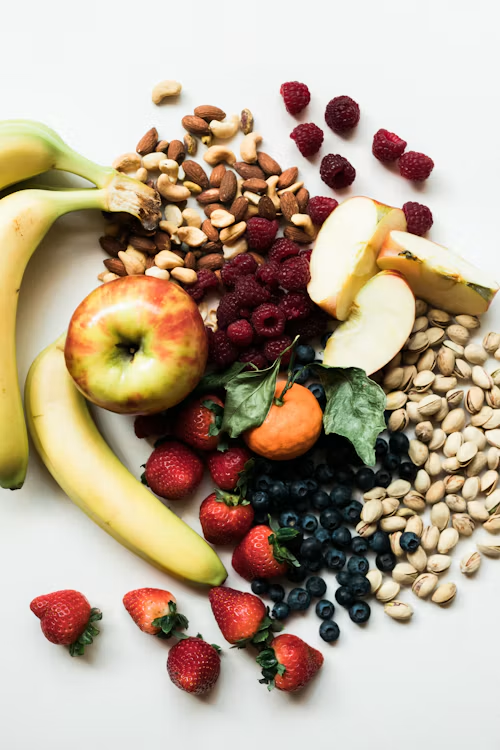
Walnuts and other nuts. Nuts supply unsaturated fats, fibre, vitamin E and polyphenols. In PREDIMED, the nut-supplemented arm was one of the two groups showing cognitive benefit. Walnuts are particularly rich in alpha-linolenic acid, a plant omega-3. A small daily handful is a practical, evidence-informed habit.
Berries. Blueberries, strawberries and other berries are rich in anthocyanins and other flavonoids. In the Nurses’ Health Study, women with the highest berry intake showed slower rates of cognitive decline, equivalent to a delay of up to two and a half years of cognitive ageing (Devore et al., 2012). This is an observational finding: encouraging, but not proof of cause and effect.
Leafy green vegetables. Spinach, chard, rocket and kale provide folate, lutein, vitamin K and nitrates. Observational data link higher intake with slower cognitive decline, and leafy greens are a cornerstone of both the Mediterranean and MIND patterns. Because they also support cardiovascular and metabolic health, there is very little downside to eating more of them.
Eggs. Eggs are a good source of choline, a nutrient needed to produce acetylcholine, a neurotransmitter involved in memory and learning. The mechanism is plausible, but clinical evidence that eating eggs improves cognition is inconsistent. Eggs can comfortably form part of a healthy diet; they are simply not a proven brain treatment.
Extra virgin olive oil. Rich in monounsaturated fats and polyphenols such as oleocanthal and hydroxytyrosol, extra virgin olive oil was one of the two key supplements in PREDIMED. Using it as your main culinary fat is one of the best-supported dietary changes you can make.
Dark chocolate and cocoa. Cocoa contains flavanols, which can improve blood vessel function. However, the large COSMOS-Mind trial found that daily cocoa extract providing 500 mg of flavanols for three years produced no cognitive benefit in older adults (Baker et al., 2023). Commercial chocolate also loses much of its flavanol content during processing, and it contains sugar and calories. Enjoy a square or two of high-cocoa chocolate if you like it, but do not treat it as medicine.
Fermented foods and the gut–brain axis
The gut–brain axis is one of the most exciting areas of nutrition science, and it lies at the heart of my clinical work. The gut and the brain communicate through the vagus nerve, the immune system, hormones and microbial metabolites such as short-chain fatty acids. Changes in the gut microbiome have been observed in people with depression, Parkinson’s disease and Alzheimer’s disease.
What can diet do? A notable randomised study at Stanford University assigned healthy adults to a diet high in either fermented foods or fibre for ten weeks. The fermented-food diet, which included yoghurt, kefir, fermented cottage cheese, kombucha, kimchi and sauerkraut, steadily increased gut microbiome diversity and reduced a range of inflammatory markers (Wastyk et al., 2021).
This matters because chronic low-grade inflammation is thought to contribute to cognitive decline. Nevertheless, it is important to be precise. The Stanford study was small, it involved healthy adults, and it did not measure cognition. We do not yet have clinical trials showing that fermented foods prevent cognitive decline in humans. The gut–brain connection is promising science, not established clinical fact. In practice, I encourage my patients to include a variety of fermented foods and plenty of fibre-rich plants, because these support microbiome diversity and overall health, while being transparent that their specific effect on the brain is still under investigation.
Diet is only part of the picture: the 2024 Lancet Commission
Perhaps the most important evidence for anyone concerned about dementia comes from the 2024 report of the Lancet Commission on dementia prevention, intervention and care. After reviewing the global evidence, the Commission estimated that around 45% of dementia cases could theoretically be prevented or delayed by addressing 14 modifiable risk factors across the life course (Livingston et al., 2024).
These factors are: less education in early life; hearing loss, high LDL cholesterol, depression, traumatic brain injury, physical inactivity, diabetes, smoking, high blood pressure, obesity and excessive alcohol consumption in midlife; and social isolation, air pollution and untreated vision loss in later life.
Notably, diet itself is not listed as one of the 14 factors. Diet does, however, influence several of them directly, including LDL cholesterol, diabetes, obesity, blood pressure and alcohol intake. This is the key message: food protects the brain largely through its effects on cardiovascular and metabolic health, and it works best alongside physical activity, good sleep, hearing care, social connection and avoiding smoking.
Practical guidance: building a brain-friendly plate
Based on the evidence above, these are the habits I recommend to my patients:
- Make extra virgin olive oil your main fat for cooking and dressing.
- Eat oily fish around twice a week, choosing smaller species such as sardines, mackerel and anchovies.
- Have a small handful of nuts most days, with walnuts as a good option.
- Include leafy greens daily and aim for a wide variety of colourful vegetables and fruit, including berries.
- Build meals around legumes and wholegrains, which feed a diverse gut microbiome.
- Add fermented foods regularly, such as natural yoghurt, kefir or sauerkraut.
- Limit ultra-processed foods, added sugars, processed meat and alcohol.
- Look after the rest of the picture: move every day, protect your sleep, have your hearing and blood pressure checked, and stay socially connected.
Consistency is what counts. A single meal or superfood will not change your long-term risk; a pattern sustained over years may.
My Thoughts
There is no single food that will protect your brain. The best available evidence supports a Mediterranean-style dietary pattern, rich in plants, extra virgin olive oil, nuts and fish, combined with a healthy lifestyle. Some popular claims, such as the cognitive benefits of cocoa supplements, have not held up in rigorous trials, and the gut–brain axis, though promising, still needs clinical confirmation. Being honest about these limits does not weaken the message; it strengthens it. What you eat every day remains one of the most powerful tools you have for long-term health, including the health of your brain.
This article is for educational purposes only and does not replace individual advice from a qualified health professional.
References
- Valls-Pedret C, Sala-Vila A, Serra-Mir M, et al. Mediterranean diet and age-related cognitive decline: a randomized clinical trial. JAMA Intern Med. 2015;175(7):1094–1103. doi:10.1001/jamainternmed.2015.1668. PubMed PMID: 25961184.
- Devore EE, Kang JH, Breteler MMB, Grodstein F. Dietary intakes of berries and flavonoids in relation to cognitive decline. Ann Neurol. 2012;72(1):135–143. doi:10.1002/ana.23594. PubMed PMID: 22535616.
