
The Gut–Lung Axis: How Nutrition Feeds the Probiotics That Guard Your Lungs
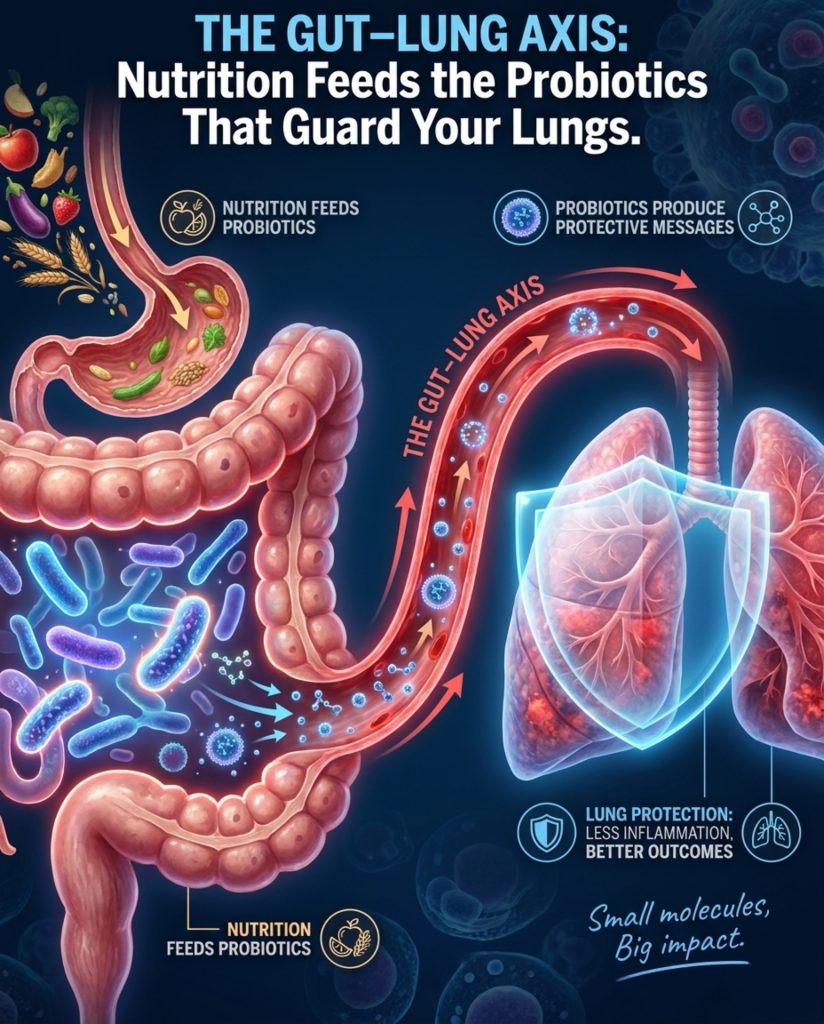
Your probiotic may never touch your lungs. Its microscopic messages might. A striking 2025–2026 study suggests that beneficial gut bacteria can send nanometre-sized parcels to distant organs and it reframes an old question: perhaps we should worry less about where bacteria settle, and more about where their messages travel.The gut–lung axisDISTANT ORGANS · SHARED CONVERSATIONS Fibre + fermented foodsthe raw materialGut bacteriaferment & signalEVs · SCFAs circulation Lungs calmer, better-defendedHow the gut–lung axis works: food shapes the bacteria, and the bacteria send the signals.
If you have ever wondered why a chest infection seems to hit harder after a spell of poor eating, antibiotics or high stress, the answer may lie a long way from your lungs in your gut. A fast-growing field of research describes a two-way communication network between the digestive tract and the airways known as the gut–lung axis. Understanding it turns nutrition from a vague wellness idea into a concrete, evidence-based tool for respiratory resilience. This article explains the science in plain language and, crucially, what to put on your plate.
What is the gut–lung axis?
The gut is the most densely populated organ in the body, home to trillions of micro-organisms. Far from staying put, these microbes and the molecules they produce influence tissues throughout the body. Reviews of the gut–lung axis describe a bidirectional relationship in which gut bacteria help set the “immune tone” of the lungs through three main routes: circulating microbial metabolites, the trafficking of immune cells between mucosal surfaces, and immune-signalling molecules that reach the airways through the bloodstream.
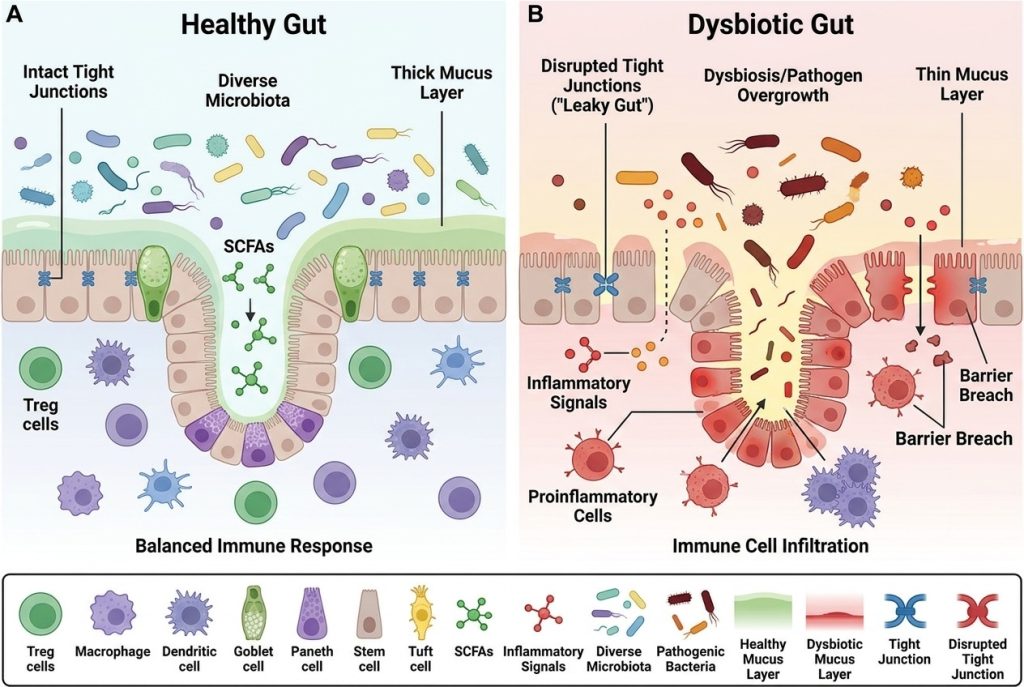
In practical terms, a diverse, well-fed gut community tends to keep inflammation measured and the airway lining intact, whereas a depleted community a state called dysbiosis is repeatedly linked in the literature to worse outcomes in asthma, COPD and pneumonia. The lungs have their own small microbiome, but because the gut holds the overwhelming majority of the body’s microbes and metabolic activity, it is the gut that exerts the larger systemic pull.
The messengers: short-chain fatty acids and bacterial vesicles
Two kinds of “messages” matter most for the lungs.
Short-chain fatty acids (SCFAs)
When gut bacteria ferment the fibre you eat, they release short-chain fatty acids chiefly acetate, propionate and butyrate. These are not waste products; they are signalling molecules. SCFAs enter the circulation, reach the lungs, and act on immune receptors (such as FFAR2 and FFAR3) and on gene-regulating enzymes to keep inflammatory responses proportionate. Several reviews now position SCFAs as a central link in gut-to-lung communication, with butyrate in particular supporting epithelial barriers and regulatory immune cells. The headline for the kitchen is simple: no fibre, no SCFAs.
Bacterial extracellular vesicles (EVs)
The newer, more surprising messenger is the extracellular vesicle a tiny, membrane-wrapped parcel (roughly 30–200 nanometres across) that bacteria release, packed with proteins, lipids and regulatory RNA. In a 2026 study published in the Journal of Inflammation Research, researchers gave mice vesicles derived from the well-studied probiotic Lactobacillus rhamnosus GG (LGG) by mouth. The vesicles did not stay in the gut: fluorescent tracking showed them accumulating strongly in lung tissue.
In a model of sepsis-induced acute lung injury, these LGG vesicles reduced lung damage and fluid build-up, lowered inflammatory signals (TNF-α, IL-6 and IL-1β), restored the tight-junction proteins ZO-1 and occludin that seal the airway lining, and improved survival. The authors traced the benefit to the reactivation of a repair pathway (HIF-1α signalling), and lung “organoids” miniature tissue models showed the same barrier-protective effect.
⚠️ An honest caveat
This vesicle work is pre-clinical carried out in mice and tissue models, not people and fluorescent labelling alone cannot prove that every signal detected in the lung was an intact, functioning vesicle. It is a fascinating signal, not a finished therapy. It should inform how we think, not what we promise.
Why does this matter for nutrition? Because it shifts the goal. We have long assumed a probiotic must colonise the gut to be useful. But if bacteria communicate through metabolites and vesicles, then feeding a thriving microbial community so it produces more of these messengers may be as important as which strains you swallow. The bacterium does not need a passport; its messages may already have one.
What the human evidence says about probiotics and respiratory health
Beyond the mouse work, there is real clinical data in people. A 2022 Cochrane systematic review pooled 23 randomised trials involving roughly 6,950 participants and concluded that probiotics were better than placebo for preventing acute upper respiratory tract infections, being likely to reduce the number of people who catch at least one, and probably reducing repeated infections. Most trials used Lactobacillus and Bifidobacterium strains at doses of around 10⁹–10¹¹ colony-forming units per day for more than three months. The effect is real but modest, and it is strain- and dose-specific an important nuance for clinicians and patients alike.
On the food side, a 2021 Stanford clinical trial (published in Cell) followed 36 healthy adults for ten weeks. Those who ate more fermented foods — yoghurt, kefir, kimchi, fermented vegetables, kombucha showed increased gut microbial diversity and a fall in nineteen inflammatory proteins, including IL-6. Interestingly, a high-fibre diet alone did not raise diversity over that short window, a reminder that fibre and ferments do complementary jobs.
Clinical nutrition to grow lung-friendly bacteria
Here is where theory becomes a shopping list. The aim is not one miracle food but a pattern that reliably grows fibre-fermenting, SCFA-producing bacteria (such as Faecalibacterium and Bifidobacterium) while keeping inflammation low.
1. Fibre and prebiotics feed the fermenters
Fibre is the substrate for SCFA production, so variety and quantity both count. Prioritise legumes (lentils, chickpeas, beans), whole grains (oats, barley, rye), and specific prebiotic-rich plants: onions, garlic, leeks, asparagus, slightly green bananas, artichokes and chicory. Resistant starch — from cooked-and-cooled potatoes, rice or pasta is a particularly good butyrate promoter. Aim to increase intake gradually to avoid bloating, and to hit a genuinely diverse target: many gut specialists suggest working towards 30 different plant foods a week.
2. Fermented foods add living diversity
Because fermented foods raised microbial diversity where fibre alone did not, they earn a daily place. Rotate natural live yoghurt and kefir, kimchi and sauerkraut (unpasteurised, from the chilled section), miso, tempeh and natto, and kombucha. Start with a few spoonfuls and build up. If you are immunocompromised, pregnant or managing a specific condition, check suitability with your clinician first.
3. Polyphenols and colour the secondary fuel
Polyphenols, the plant compounds behind deep colour and bitterness, are metabolised by gut bacteria into anti-inflammatory products and selectively encourage beneficial species. Load the plate with berries, extra-virgin olive oil, green tea, cocoa, herbs, spices and colourful vegetables. Think of polyphenols as fertiliser for the good bugs.
4. Barrier and immune support the supporting cast
Respiratory defence also depends on the airway lining and a well-regulated immune system. Omega-3 fats from oily fish support the resolution of inflammation; adequate protein maintains mucosal repair; and micronutrients including vitamin D, vitamin A, vitamin C and zinc are classic partners of immune competence. These are best obtained from food first, with supplementation reserved for tested deficiencies and individual clinical judgement.
5. Protect what you are building
Growing a good microbiome is only half the task; the other half is not tearing it down. Where possible, minimise ultra-processed foods, excess added sugar and unnecessary alcohol, use antibiotics only when genuinely indicated, and treat sleep and stress as part of the prescription — chronic stress measurably shifts the gut community.
A day on a lung-friendly plate
- Breakfast: oats with kefir, berries, ground flaxseed and a few walnuts.
- Lunch: lentil and mixed-bean salad, olive oil, plenty of colourful veg, a side of sauerkraut.
- Dinner: oily fish (salmon, sardines) with barley or cooled-then-reheated potatoes, garlic-and-onion greens, miso soup.
- Through the day: green tea, herbs and spices, and water; aim across the week for that 30-plant target.
Reframing the question for probiotics
The vesicle research invites a more sophisticated way of thinking. For years, the interesting endpoint has been colonisation did the strain take up residence? The emerging picture suggests a second, equally interesting question: where do the bacterial messages go, and what do they do when they arrive? For clinicians, that means valuing dietary patterns that maximise beneficial metabolites, not only supplement labels. For patients, it is oddly reassuring: you do not have to permanently re-engineer your entire microbiome to benefit you have to feed it well, consistently.
Key takeaway
- The gut–lung axis is a real, bidirectional network; gut bacteria help set the lungs’ inflammatory tone.
- Bacteria communicate through SCFAs (from fibre fermentation) and extracellular vesicles — messages that can reach the lungs.
- Human evidence supports a modest, strain-specific benefit of probiotics against respiratory infections, and a diversity benefit from fermented foods.
- The most reliable lever is food: diverse fibre, daily ferments, polyphenols, omega-3s and key micronutrients.
- The exciting vesicle findings are pre-clinical promising direction, not proven treatment.
If you would like a plan tailored to your history recurrent infections, asthma, COPD, post-antibiotic recovery, or simply building resilience before winter this is exactly the kind of protocol we design at Smart Nutrition International, always personalised and always evidence-led.
References
- Yan F, et al. Lactobacillus rhamnosus GG-Derived Extracellular Vesicles Accumulated in Lung Tissue to Attenuate Sepsis-Induced Acute Lung Injury by Suppressing Inflammation and Restoring Barrier Integrity. Journal of Inflammation Research. 2026. doi:10.2147/JIR.S575596
- Zhao Y, et al. Probiotics for preventing acute upper respiratory tract infections. Cochrane Database of Systematic Reviews. 2022;8:CD006895. doi:10.1002/14651858.CD006895.pub4
- Wastyk HC, et al. Gut-microbiota-targeted diets modulate human immune status. Cell. 2021;184(16):4137–4153. doi:10.1016/j.cell.2021.06.019
- Reviews of the microbiota–gut–lung axis and short-chain fatty acids in pulmonary immunity, incl. Frontiers/PMC syntheses (2022–2026): “Respiratory diseases and the gut microbiota”; “Butyrate: connecting the gut-lung axis to the management of pulmonary disorders”; and role of SCFAs (FFAR2/FFAR3) in innate lung immunity.
- Chen L, et al. Probiotic Lactobacillus rhamnosus GG reduces mortality of septic mice by modulating gut microbiota composition and metabolic profiles. Nutrition. 2020;78:110863.
Medical disclaimer. This article is educational and does not replace individual medical or nutritional advice. Dietary and supplement changes — particularly for anyone who is pregnant, immunocompromised or managing a chronic respiratory condition — should be discussed with a qualified professional. Smart Nutrition International © 2026.
